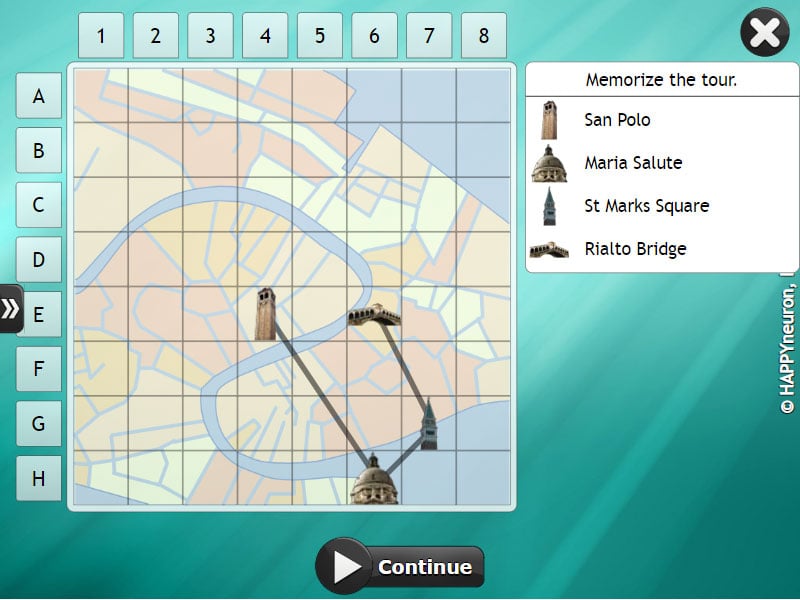
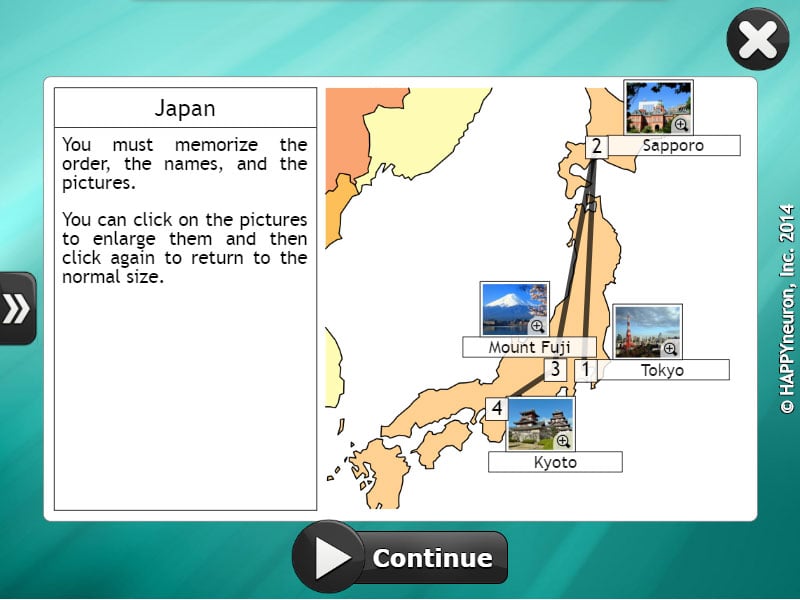
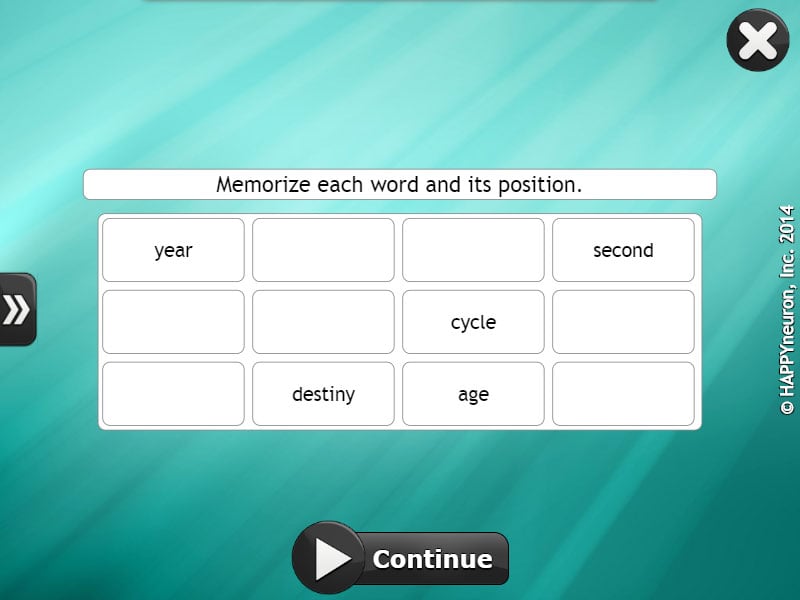
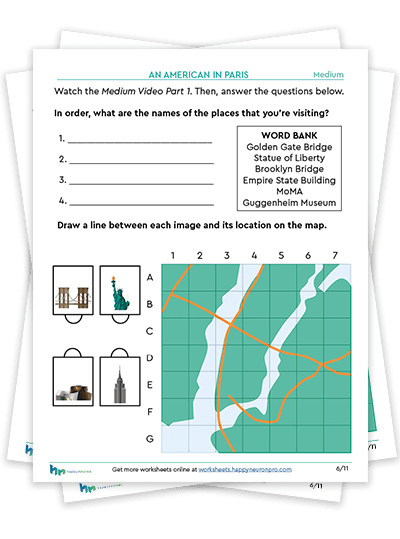
In this exercise, the user must memorize travel itineraries in one or several cities by correctly pairing landmarks with their location on a grid. The user must develop strategies to remember what a landmark looks like and pair it with a number and letter location on a grid.
The exercise challenges your visual-spatial skills and your visual memory. The primary areas of the brain exercised in this exercise are the right parietal cortex and the right temporal cortex. Visual-spatial skills allow us to perceive objects and the spatial relationships among them visually. Spatial memory is a subcategory of visual memory because it relies on a cognitive or mental map whereby an individual can acquire, code, store, recall, and decode information about the relative locations and characteristics in one’s spatial environment.
Good visual-spatial skills are needed to orient yourself in a neighborhood, to retrace your steps through a crowd, to remember landmarks, and also to be able to recognize that you are in an unfamiliar environment. Individuals may use the same skills in American in Paris when they go to a large parking lot and have to remember where they parked their car, or when they are traveling, and they have to remember the location of their hotel.

A very high degree of control is available. The parameters that can be selected are:
Over 1,600 unique exercise configurations and significant data set depth.
Maintenance is scheduled on this website on Tuesday, January 20, between 8 and 9 a.m. (GMT).